
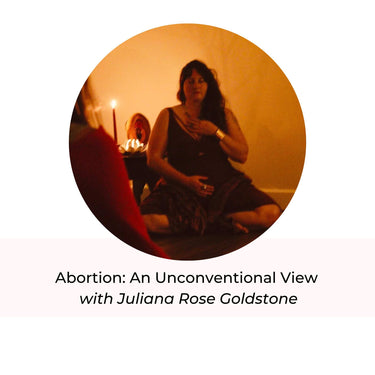
Kit Maloney, founder of Kitara has been advocating for reproductive choice and freedom for over 20 years. Yet this conversation is like none she's ever had before.
As womb healers, Juliana and Kit hope to broaden the conversations we’re “allowed” to have around reproductive choice and freedoms – and the physical, emotional, and spiritual impact that may have, honoring that everybody's journey is unique and special.
Pregnancy termination is a controversial, taboo, and polarizing subject that can bring up a lot of strong beliefs and big feelings. The commonness of abortion and narrowness of storytelling on the topic leaves many women alone in their decision, without spaces to integrate or heal afterwards, and also ignores the nuance and paradox we as women experience as the guardians of the threshold of life and death.
What does it mean for us to have both life and death move through our bodies? How do we process the loss of life physically, mentally, and spiritually?
Juliana honors the importance of claiming our rites (not just rights) and owning them through ceremony, or spiritual practices and rituals (including yoni steaming). We discuss how to remember and reclaim these rites, and wear their inherent truths into our culture as we navigate the cycles, rhythms, responsibilities and decisions of living in a body with a womb.
The silencing of these nuanced conversations that hold paradoxes with love and compassion keeps us isolated. This is our one small step towards creating supportive spaces for women to explore their experiences within a grounded and loving container.
Ultimately, weaving the fragments of our experiences into a story we can claim, make sense of and feel whole within is our hope and wish for women who have ended a pregnancy. Know that you are not alone and there are practices and healing spaces to support you in holding this.
We hope you’ll listen with an open heart, in your own timing and for your own healing. Through Kitara, we honor that we each come to this topic with our own beliefs, feelings, and journeys. We’re here, doing our best, to hold it all with compassion. Sending love.
About our Guest
Juliana Rose Goldstone of Boldly Embodied is a Somatic Sex Educator, Pelvic Health Specialist, psychedelic guide, mother, and lover living in the green mountains of Vermont.
She has both in-person and virtual offerings for hands on pelvic care, psychedelic experiences, as well as a Mystery School specifically designed for mothers.
Follow Juliana on Instagram and learn more about her many offerings on her website.
About Kitara and Womb Stories Project
Womb Stories Project is the in-house podcast of KitaraLove.com, your one stop shop for everything you need for safe and effective Yoni Steaming at home.
Kitara is a yoni steaming company made up of devoted womb healers. Our passion for steaming is rooted in the profound healing we’ve experienced ourselves and witnessed in those we support. We are devoted to supporting your womb health and healing journey.
Our founder, Kit Maloney, holds a Masters Degree in Gender and Social Policy from the London School of Economics and has spent the past two decades as a thought leader on victim advocacy, pleasure activism, and holistic womb health and healing.
Kitara provides beautifully designed, expertly crafted tools for safe and easy in-home yoni steaming. Shop steam set ups, herbs, and accessories here.
Episode Timestamps
00:00 – 01:57 Introduction to Womb Stories Project
01:57 – 07:27 Why Abortion Conversations Stay Stuck
07:27 – 12:50 The Spiritual Rite of Abortion
12:50 – 14:53 Holding the Full Spectrum of Abortion Experiences
14:53 – 17:26 Breaking the Taboo: Aftercare & Belonging After Abortion
17:26 – 25:47 Kit's Personal Abortion Story & Sexual Trauma
25:46 – 28:50 Spirit Babies & Integration After Abortion
28:50 – 31:36 Yoni Steaming for Abortion Healing & Grief
32:47 – 36:59 The Paradox of Choice
36:59 – 40:22 Trauma After Abortion & the Ongoing Healing Journey
40:22 – 44:53 Scar Tissue After Abortion & Emotional Release
44:55 – 48:13 Reclaiming Your Story: Weaving Fragments Into Wholeness
48:13 – 50:22 About Juliana: Ceremonial Pelvic Care & Mystery School
50:23 – 52:16 Healing Through Connection and Ceremony Kitaralove.com
Transcript
Kit Maloney (00:00)
Thank you as always for pressing play on Womb Stories Project And thank you particularly for choosing to press play on this episode. It is likely if not inevitable to bring up more controversy than most of our episodes do. Of course I know And I also wanna say that this is a conversation that is like none other I've ever had,
and I've been speaking about abortion for over 20 This is really intentionally different. It's two women who are womb healers coming together to share what we've learned through our own stories, through our own lived experience, and through holding and bearing witness to hundreds of other women who have journeyed through the experience of choosing to terminate a pregnancy.
We speak to the physical, the emotional, the spiritual impact that this may have, owning that everybody's journey is unique and special, and holding this intention that as we storytell, we're able to choose and note where we find resonance in somebody else's story, where we find healing, where we find inspiration and hope. We hope that this conversation is full of that for you as well.
So if you continue to listen, please do so taking care of yourself, get yourself some extra grounding tea, take some good breaths, feel free to press pause if and when it feels like it's time to shift and to tend to yourself and know that we both finished recording and quickly said, oh, I'm gonna go have a steam now. So please consider all the modalities available to you,
to help you integrate the conversation and continue in the highest expression of your womb health and healing journey. Sending so much love.
Kit Maloney (01:57)
Thank you so much for being here today. It is such an honor and this is a conversation we're about to have that I am really looking forward to. I have truly never spoken this conversation out into the world such a beautiful opportunity,
it comes with a bit of trepidation, but also so much gratitude for the opportunity. I wanna invite you to speak about who you and what your work in the world is to help ground and orient us. Then I'd like to go in and share some of the written work that was the catalyst to set up conversation today.
Juliana (02:43)
Yeah, thank you so much Kit for having me. It's really an honor to be here conversation has been weaving itself into being for some time now. I'm just really excited to sit with you and share our hearts and share our stories. So who am I in the world? I answer this question different each time, so we'll see what comes out this time. I am a hands-on pelvic care
practitioner, devotee to the pelvis and the womb. My work really centers around scar tissue. So I am certified and deeply devoted to the practice of scar tissue remediation and scar That extends beyond physical scar tissue, right? I do hands on work with episiotomy scars, with caesarean scars, with, you know, all of the scars that we may
find in our bodies, in our pelvises, and the surrounding areas, but it also extends to the existential scar tissue. What is the scar tissue that we carry from just the experiences of walking through this world in the we are walking in? That's a big part of my work. I'm also a somatic sexologist and pleasure doula, so we can't have a conversation of pelvic health without also talking about pleasure.
And I am also the guide and creator of the Bone Song Mystery School, which is, to my knowledge, the only mystery school that is really created by and for mothers to really walk us through the very specific Priestess Path Mystery School of what it is to be a mother in these times. So those are the sort of main pillars of my work right now.
Kit Maloney (04:23)
Beautiful. ⁓ so beautiful. Okay, well on this theme of motherhood, we are really holding the space to talk in a really honest, personal way around what it means to be presented with the chance of motherhood and to decide not to go forward with a pregnancy. Through abortion or termination, I will use both of those terms as they resonate and shift differently in my narrative.
But I will just say that I have been thinking about the limitations of the ways in which I feel safe in talking about abortion for many, many years, many And I'll get into my personal story in a moment, but
there's something interesting that happens, I think, when you step into your thirties and it really shifts because the conversations and the awareness around terminating pregnancy is now often a choice that's happening amongst women who have children already. And it just seemed to bring an even deeper level of complexity into the reality of how few healing spaces there are.
And in the current cultural moment, this gets really, the whole topic gets so siloed into a pro-choice, anti-choice paradigm that it seems like it sucks all the space from really the heart-womb connection and the reality of the experience of all aspects of unplanned or unwanted pregnancy.
And so when you speak of scar tissue, I really love that for so many reasons, because it is something that I can visualize as an image that makes almost this emotional residue more concrete. Because I think a lot of us might actually have literal physical scar tissue,
but definitely have emotional and spiritual scar tissue. That is so important and meaningful to oil and massage and love upon and to welcome as here, because it's here. And we don't get a lot of opportunities to name that So thank you. I was having a conversation with a very dear friend,
who is a beautiful, incredible mother who had chosen to terminate a pregnancy. She was really speaking to how narrow the conversations she could have It's scary in this climate to even speak that reality out loud,
to a best friend of many, years. She was able to kind of access the conversation through sharing that her primary doctor was not able to help her any longer because of the hospital's religious affiliation. And that was sort of an interesting entry point considering that I think what was really on her heart and in her being was
this question of where the grief could be and could it be named if it was alongside the gratitude and the knowingness that it was the right choice for her at that time. And so I had just been in this very deep inquiry and witnessing and listening and feeling if I admit a little bit victimy and frustrated that I was in a story of like, there aren't spaces to have these conversations.
And with that, I was truly blessed by your post about just this. And so with your permission, I would love to read this Instagram post that was so powerful that had me reach out in a teary gratitude DM voice text and facilitate this one and then this conversation.
Okay, this is Juliana's post from November 15th, 2025. I'm gonna read the series of beautiful slides first. As we demand and defend the right to choose, modern women have forgotten what it actually means for death to move through their bodies. We are encouraged to celebrate and be grateful for modern medicine
and the miracle that we didn't have to give up our lives or careers or our rightful place in society for a child we do not want. But in the privacy of our own hearts and bodies, there is a primal grief, a permanent mark of death having passed through us that never leaves us and that our culture has no idea how to hold. Now let me be crystal clear.
I support a woman's sovereignty to choose what life she does or does not bring through her body. I always will. But choosing death without the acknowledgement of the weight that carries is making women sick. I have worked with many women who feel very confused by the mix of grief and relief they feel after a pregnancy release.
The unmetabolized grief lives in our wombs and takes up residence in our tissues. It took me years to recognize the unmetabolized grief that was living in my body after my abortion, even though I chose it. As bringers of life, women are also the keepers of the threshold of death. And it is time we re-remember the rites and spiritual responsibilities
that come with that. Hands-on, hands-in ceremonial pelvic care is a space where these rites can be remembered and the sacred nuanced complexities of rights, we are fighting to defend can be explored. On the table, there is space for all of it. The wisdom of your body speaks between, beyond, and around political beliefs,
and gets right to the heart of a truth much more real and ancient. So yes, let us fight for our right to choose without forgetting what the fullness of that choice entails.
I feel so grateful to be living in a time where we can have these conversations. And I just want to honor all the women
and all the men who've loved us
to get us to this point, because I am struck by the need for these conversations and the privilege it is to have them in ways that my mother at my age and my grandmother and great-grandmothers would not have had access to. So really feeling the lineage
and all that was fought to bring us here. And hopeful that these conversations will bring forth a different reality and experience for our children. So thank you. I will now give you an opportunity to take part to that.
Juliana (12:22)
Oh, thank you so much, Kit. Yeah, it's a really interesting experience to hear those words read back, you know, after some months. I mean, that post went more viral than anything that I've ever written, is a really interesting experience to have because, I mean, my hands were shaking when I wrote it. It was like, oof, this is... And that's how I know when something needs to be spoken, right? It's like...
when my voice shakes, when my body shakes, when my hands shake. It was literally like I woke up in the morning and it just came through. It was just this message that needed to come through and it was met with lots of gratitude, lots of resonance, and also a lot of pushback as well of like, it's not an experience of grief,
for everybody. To be able to sort of widen our aperture does this conversation actually get to be and can we create space for all of the experiences, right? So following that, I then created a space called Fertile Fallow, and I will probably create this space again,
where, we brought this conversation off of the social media and into a private space where we could really talk about it actually work with our bodies and with our tissues, with the beautiful practice of steaming. guess one of my kinks, Kit, I have to say, is paradox. It's like paradox nuanced conversation, right? Where both can be true. We can be both
grateful and grieving. We can be both relieved and so sad. I love, creating these spaces where we can have conversation where two seemingly opposite, realities can be true and maybe that's a feminine experience, I think, of something
that I've noticed of just like feminine energetics where there can be this nuance that it's not black and white, right? There a right or a wrong or a true or a false. There's something else. And so I feel like this conversation around terminating pregnancy, this conversation around abortion gets to be that because it is so complex.
I think the narrative that has been really prominent in our culture is that it is only, teenage girls, teenage pregnancies, an oops or an accident. There's this narrative of the sort of naivety that goes with it as well, which is also true. You know, this is not to say that this is not a true story, but there's also,
women who are in their 30s who maybe already have two or three children who know that it's not the time, who are in devoted, loving, committed partnership and who know that it's not the time in the space to bring forward another child. You know, there's this whole other side of the story and I feel like that actually does not get told where it can be a very informed, grounded,
decision. course we speak all of the ways that this can actually happen, right? From herbal to, at home to in clinic there are many, many ways. And then whenever shame or taboo around something, it makes it very difficult to actually have aftercare spaces for ourselves. So we go through an incredibly intense experience like that.
And because we're either being good feminists and we're like, I exercised my feminist right to do this thing that, you know, my grandmothers didn't have access to, so therefore I should feel grateful and, move on with my life. There's that side of the story, right? And there's no space in there to also feel the complexity of the, what if, like, what if, who would this child have been? What would it have been like to have carried this, birth this person through my body?
And then on the other side, the shame of it. The shame or the hiding or having to go against our own religious beliefs or beliefs that kind of keep us belonging into a certain group of society as well. So there's a whole spectrum and my intention with writing this piece and starting this conversation was to like, let's just air out the house a little bit.
Let's open all the windows and the doors and just see when we're not trying to like stay in one narrow lane what conversations can be had.
Kit Maloney (16:45)
That is what I resonated with so much. It helped me see even more consciously how much I was in a more narrow lane than I understood myself to be. Because of not knowing that it was like a multi-highway, multi-dimensional highway in space. But I just didn't know because that hadn't,
ever been introduced to me in my journey here. So I think I will orient people with my journey up until today, which to get sort of to the point is that I terminated a pregnancy in my early 20s and I already in my early 20s was a real advocate for abortion rights.
Had been to national marches, had been working on college campuses, to support women's rights to choose access to abortion care. I was also really involved in work to prevent and appropriately respond to sexual assault. And I was in that work very deeply.
when I experienced a sexual assault, which I...
struggled to navigate healing from, particularly because it seemed to take much from me, including my identity, at being somebody who was in the work of advocacy for sexual victims and survivors who didn't have direct experience. That felt so important to me. I wanted more of us. And then I was no longer one.
I say this because it's my truth and because I've now heard hundreds of stories that show me that this is really an archetypal journey almost. So I just, I want in case somebody else is hearing this to feel as seen as I've heard when I've heard somebody else share this, but it really left a very strong and traumatized blueprint on my sexuality. And I started not tending to myself and my sexuality,
in safe ways and had consensual but lots of more reckless sex because of that assault. From those experiences became pregnant and was very disassociated from my body in those days and was surprised I was as pregnant as I was. Lots was going on in my life. A friend had been hurt and
I found myself about 11 weeks and knew very clearly that I was not going to continue with the pregnancy. I was literally moving across the country two days later to start my master's program. So I called Planned Parenthood and I had an abortion. And later that night I flew to London.
about like, no time to process. Oh I look back on that young woman and I'm like...
proud of the strength and the like logistics and the certainty and I'm also just like my goodness thank thank God your best friend was there to be with you and to hug you but also then it was like well relief gratitude that's what to focus on and I was I was but I didn't know I was on this multi-dimensional multi-lane highway I also thought that that was it so really double down on that
because the only other option was a devastation that carried so much self-blame, it would break me. So I went along my way for years and years and conflict in the paradox that you were saying, speaking to, that like this was absolutely the right choice.
And I felt so conflicted about having made How can those two things be. I will sort of do an asterisk here. This is my personal journey. listened to hundreds of women. So there are threads that connect us sometimes. There are women who don't feel this tension. And so I'm not meaning to place that on them.
I'm just naming for myself and anybody who has a thread that is helpful to them to hear to pull here in this conversation with the intention of healing... were a couple of moments that I did wanna just speak to knowing we were going to be having this conversation today. One was, let's say like six, seven years later,
in a family conversation, I come from a very liberal family, was very welcomed and supported to go to the national marches for RU486 in 2000 on the national mall, which is now called the abortion drug. That was a very culturally supported thing in my family. So that's my background. And yet I was...
raised in the Catholic Church until I was about 10. But then the family narrative there was that the Pope around that time said like categorically women are not equal enough to be leaders in the church and my mom pulled us out. And so even that was like a very feminist stance within and it was jarring because we had to go every Sunday until we shouldn't go. And
I was in this family conversation where we were talking about women's rights from our perspective and fighting for the right to choose. My mother said to me, sometimes I wish I had had an abortion so that I could speak more publicly about it. Because we were talking about the dearth of voices and actually remembering,
that in the early 70s, one of the early Ms. magazines was a collage of so many prominent women coming out with their abortion stories. And noting that 30 years at that point on how rare that would be. You don't have US senators now talking about abortions. You don't have moguls of business talking about abortions in the way that you actually did in the
So my mom, this wonderful business leader and executive, she was coming from such a beautiful place. But when I heard her say that I just shut down and I went to bed, I thought, you don't know what you're talking about. And I spoke to her about having had an abortion for the first time the next morning. I wanted to share with her like what had happened because I could see she could see me shutting down. And that was beautiful to name that and to feel that support.
But I'm not really sure we've ever talked about it since. And that was probably about 10, 15 years ago.
just want to name that it was such a part of my fertility journey. And I about eight weeks into the first pregnancy I had had that was so intentional. And I really struggled in processing that because that scar from my abortion 20 years earlier was so much more gnarly than I had ever been willing to look at.
And so a huge part of my fertility journey was coming into a heart space piece around that decision in my twenties and really working with all of the different stories that were paradoxes, but coming at them with peace and love and compassion for the paradox rather than the traumatic swirl of judgment and shame and blame that I do think the trauma
guide the paradox in one way and the peace and healing can hold a paradox in such a different way. And really doing that inner work and steam was a huge part of that for me and guiding me into that loving womb space, forgiveness, that shift into self-reclamation and self-responsibility from the self-blame and shame, allowed me, I believe, to step into
healthy pregnancies after moving through all of that. So I dropped a lot in there. I'd love to hear if and what any of that brings up for you in these considerations to thank you because I have been really dropped in from using steam to support the Kitara community through terminations to seeing how different my whole journey would have been,
had I had somebody like you to hold me in a ceremony closer to the time and to hold all of the complexity, much pain that would have saved me and so many others. So thank you, you're doing it now that is so profoundly beautiful.
Juliana (25:45)
Yeah. Well, I just want to really honor your story. It's a courageous thing to share So much sort of paradox and nuance and complexity, right, of knowing it was the right choice and still being confronted with grief and
as a practitioner, I'm always thinking about, what is the physical marks that an experience like that leaves? What is the physical scar tissue? And then what is also the emotional and the spiritual scar tissue? And so your story just speaks,
to all of that so beautifully. And sometimes we don't know what the emotional and physical scar tissue is until we have sort of moved into, another sort of fertility experience, whether it's a miscarriage or a subsequent pregnancy. You know, I've worked with many women who, I just worked with someone recently who had chosen to terminate a pregnancy and then quite soon afterwards got pregnant again and chose to keep that pregnancy
And a lot of her work with me during her session, during her immersion was really about reconciling the choice of like, know in my being that this was not the right time. And then quite quickly, it changed to be the right time and to be able to come into that deep
part of our work together was like, how do we also invite, we like to call them spirit babies, how do we invite the spirit baby to be an ally, be a part of this family, to be a part of the conversation and that we don't necessarily have to act like it never happened. So part of that was ritualizing the choice, but also creating this bridge from this choice to the next choice, which was to carry a pregnancy and to
to have a baby. I think a lot of scar tissue work is about of weaving together the parts of ourselves that we feel need to be separate. We feel need to be, you know, partitioned, that we feel need to be kind of like, okay, this needs to be over there, that needs to be over there, these narratives can't coexist, so part of that scar work is like, well, how do we make this into a cohesive story?
That we can tell, at least to ourselves, like here is, my hero's journey of what it has been to be in my body and the choices that I've made and why I've made them. There's been quite a few women that I've worked with hands on, that that's been the story of like reconciling, like why wasn't it the right time then and why is it the right time now? It's one thing to have an idea of
the narrative of the story or the process in our mind. It's another thing to really listen into the body, the wisdom of our tissues, the wisdom of our body, the wisdom of our womb, the wisdom of our pelvis, the wisdom of our scars of like, does my scar actually have to say about this? What does my womb actually have to say about this? What does my heart actually have to say about this? I find that those stories tend to be much more rooted in the truth.
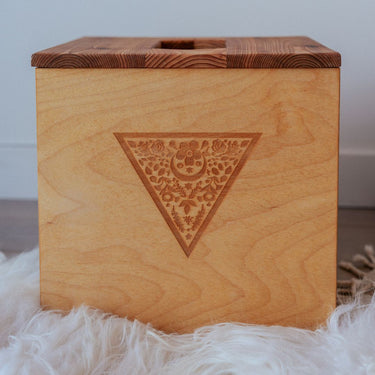
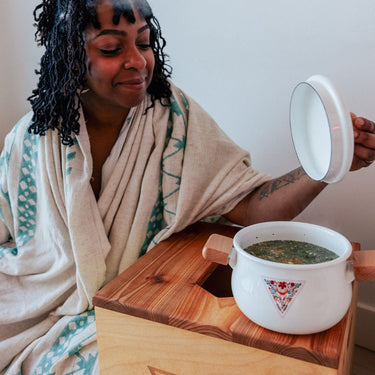
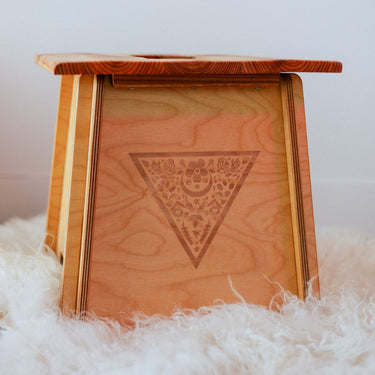
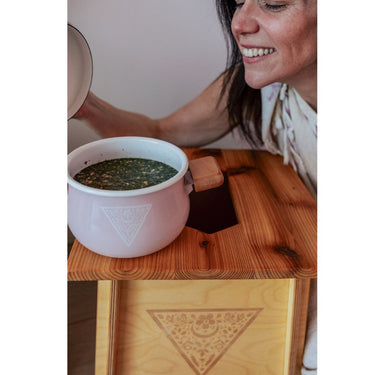
Perhaps, or less touched the narrow cultural idea of what's allowed and what's not allowed. You spoke about steaming and I wanted to just touch on that a little bit because obviously you think about steaming. I have your beautiful stool right here. I'm looking at it actually. There are...
many practices, right, that we can learn to kind of come back throne, come back to our center. Steaming is one of the most beautiful, simple, accessible ways I find, especially around this topic, especially around abortion, where we do often feel like our embodied authority, our embodied sovereignty
has been taken in some way. And so to really be able to come back to our throne, back to our embodied sovereignty, our authority of like, this is a choice that I made. How can I soften into that choice? And also how can I center back into the center of my body with all of the swirling emotions, everything that's happening there? And so I found that steam has been, a beautiful, simple, gentle,
practice to be able to move the grief. There's a lot of dignity and how it feels sit on a steam, root soft heart open, where a lot of this, this work can start to happen. So I just wanted to name that as well. Thank you.
Kit Maloney (30:04)
Yeah, yeah dignity. I'm sitting with that. I so resonate. And that's really powerful. I've not quite ever used that word or that energy, but it is a practice that can return that dignity to the embodied expression and knowing, is beautiful.
The scar tissue, can you speak to it now? I'm fascinated. I'm like, maybe the steam was actually working even more in the physical level than I understood because I was aware and able to kind of read the ways that the practice was helping me come into this peace around the deep grief of the miscarriage, which honestly I felt like I wasn't allowed to be in because of the abortion I'd had.
That was the mental loop I was in, which of course made the pain of the grief that much worse. So it just spiraled me down into this inner world that was so dark. The steam started lifting me back into these truths that you speak of, of like, this was a wise choice. You are grateful for having it and it was a heavy choice. And you knew that. And though it was a quick,
decision and a quick process. It wasn't and it was heavy. I think that that was something that was important for me to claim. And I've said to some people over the years and I know the look of shock in other sort of liberal, I don't know what terms to but other people who really advocate for abortion rights. When I say like, well, women are choosing,
to terminate, which means to end a life, to end the pregnancy. And these aren't words that are often spoken because we're so fearful of what they'll mean to our rights. And so I get that I've avoided them for so long too. And they were really important for me to say out loud, even if just to they felt true. They seem categorically true to And I want to be able
part of my healing is to feel that capital T truth throughout my system. it was hard and scary that was a truth I thought I wasn't ever meant to know or to say. yet I think that that, yeah, that dignity that this steam brings back, it allows for that soft, gentle holding of the paradox.
Juliana (32:46)
Yeah, yeah. Yeah, one of the you know, in that post, I kind of played with the word right.
Our grandmothers and our great grandmothers have fought for us to be able to have the right to choose, which is extremely important. And then there's the rite, R-I-T-E. The right of what does it actually mean to be a guardian of the threshold of life and death? What does it actually mean to be the ones who actually have to make this decision. That is a big deal, I think. And
you've already spoken to this and I want to say like I don't think that this is everybody's experience, but for me this has been my experience where so to share a little bit about about my story, I chose to terminate a pregnancy when I had two children already. I had two children. I think they were probably like three and five somewhere in there in like that, you know small
small age. And it was very, very clear to me that the relationship that I was in at the time, the pressure that was present in my life was not conducive to another child coming into the world. My body knew it. My heart knew it. And it was the most challenging decision I've ever had to make.
I was in midwifery school at the time. So luckily I had a lot of support. I was supported by a beautiful community of midwives who really had a deep understanding of what this actually meant. Not to mention access to ways of doing this at home, which is what I chose to do. I actually chose to have the abortion at home in the most way possible. My spirit grandmother was there,
it was really as ceremonial and beautiful as it possibly could be. And yet there were these deep markers of grief that, and in some ways it was similar, it was like, but it was so beautiful, we did such a such a beautiful sacred job, of walking through this rite in the best way that we could. And there
were these places that just couldn't be touched, no matter how ceremonial it was, no matter how right it was, no matter how beautiful it was. For me, one of those moments was realizing, after the abortion, I had already started to produce colostrum milk, right? So my breasts had already started. that shook me and shocked me that my body was already
readying itself to provide for this baby that I had chosen not to have. And there are these little many moments like that of the paradox, body holding both life and death at once and what that felt like and that there was no language, there was no framework, there was no map already existing to be with that. So for me,
I think that was the seed of there's something missing here. And it would take me many, years in many ways, I'm still integrating this experience. I think we always are, but it would take me many years to sort of start to tease apart the big tangle that was that experience, because there are physical considerations that we need to take, you know, to make sure that we're doing it in a physically safe way, that the timing is correct, that
we have the physical support that we need, that the kids are taken care of, there are all of these sort of physical considerations. And then, you know, because I am who I am, there are also a lot of spiritual considerations that I into place as well. And yet there was still something else that none of that could touch. I've finally been able to put words to the RITE of R-I-T-E
the right of choosing death and how do we actually, it's not just a one-time choice, it's something that we live with. It's an embodied living experience that I now There's wisdom, there are codes here that I now hold that I didn't hold before of having actually gone all the way through that process of going from life to death inside of my own body.
I don't actually know the answer to this question, I don't actually know what the rites need to be for us to move through this process, but I do believe that there's a missing piece of the conversation and that just having it, being able to recognize this experience as a spiritual rite of passage, right, as like a rite of passage of being in a female body.
At least kind of puts this experience into a different category than just a right that we or a medical experience that we have that then we move on from and don't think about again. Because I can say for myself and I can say for many of the women that I work with in my practice,
it's not a one-time thing. It's not one-undone. You know, so many women have this experience of seeing a five-year-old and having that moment that flashes by. Oh, I might have had a five-year-old, these markers or these milestones in our family. What would it be like to have three children at the table instead of two? You know, there are lightning-quick that we have
that then, because we don't really have a place to like land it often create more trauma, I think in our systems because there's this I shouldn't be feeling that or ⁓ I should talk to somebody about that. Who do I talk to about it? I think we're doing it right now. We're creating a space to at least just start to have the conversation.
Kit Maloney (38:23)
Yeah, yeah. That was going to be my reply to you of you're doing it. You know, we don't know how to do it and yet you're doing it, you're creating it. That's so beautiful and so powerful. And I really do think this expansion of who we get to be as female bodies
it's so profound. And I love your ability also to name that we are still in inquiry of what this right is and to also name that there isn't a finality point. And that's the healing journey, right? Like there just isn't. Those flashes I resonate with so much. And I also really want to honor you,
for leading these conversations and this work and also sharing your story in this moment. In these times, even in these times, especially in these times, I'm not sure, it just depends on the way the wind blows in the moment to us and our hearts and our roots. But it is beautiful and courageous and really deeply healing and meaningful to me.
And I know so many others. Thank you, Juliana.
Juliana (39:33)
Yeah, yeah. Thank you for creating the space. And, you know, one thing that's coming to mind, you were asking about scar tissue. Is that there is actually often physical scar tissue that is left over from an abortion. That even that, we don't talk about it. And generally, the providers of abortions don't talk about it either because we are wanting to protect
the safety, the sanctity of this even being an option. And so when a woman comes to me and she has scar tissue in her cervix or she, you maybe has had a difficult birth or she's wondering about, you know, the dilation of her cervix with the scar tissue to be able to just talk about it and to, to be able to actually physically hold that scar and always, always, always when we hold the scar, there's emotional content, right? Because scars are really,
they're like time capsules, Whatever you were feeling, generally, whatever you were feeling at the time when the scar was created lives in the tissue. And when we start to allow it to breathe, right? When we start to work with it physically, we work with it emotionally, we let the river flow again, right? We're taking the dam away.
We can start to at least feel the full spectrum of emotion that was there. And so often when we the emotion that is in the scar, the scar itself starts to soften and melt as well. I wanna speak to and normalize the fact that, know, abortion can be physically a traumatic experience. It can be a painful experience. It can be, a medically intense experience. And I think we even minimize that
because we're trying to make sure that that right doesn't get taken away, right? We're trying to say, it's no big deal. It's safe procedure. And it is. And here we are in the paradox again. And it is intense. It can be scary. It can be painful. It can leave scar tissue. And so again, I want to just, if anyone who's listening to this, you you do have...
ongoing scar tissue or even pain or just a sensation of trauma or holding or tension in these areas that have experienced this event. Even when our minds have an idea of what this is and why we're doing it that it's right to do it, that doesn't mean that it doesn't register as trauma in the body. And I think medical surgical trauma is some of the most complex trauma because it's like,
chose to do this, I wanted to do this, and yet our body is like, whoa, something very wrong is happening, right? Things aren't supposed to go that way. And so to be able to just reconcile both, this was the correct choice, I made it for the reasons that I did, and my body's registering it as trauma, and that we can actually work with the trauma of it without making ourselves wrong for having made that choice, without
making it any more than it is, I think it's really important to hold those nuances, especially when we're starting to do the hands-on work of healing.
Kit Maloney (42:37)
Yeah. Yeah.
Thank you.
I'm just realizing how much
is ironically silenced and suppressed under the guise of keeping the right R-I-G-H-T here. And the pain that was present in the actual moment of my surgical abortion, but I was told I must have misunderstood. Because it wasn't meant to be as painful. I'm just remembering that almost
for the first time in so many years. And then this reality that you spoke to, which I know is really confronting for so many women, the colostrum or the other signs that the body is postpartum. The body was preparing for this to continue. We intervened and how to navigate that with the physical as well as the When we're in this scoop of
real falsities that shouldn't be named. So then it's like, how do I even express let alone confront what it's bringing to me? So I can absolutely see the ways in which somebody holding with softness, with reverence, that scar for us, can be so powerful. And I'm really, thank you, you're helping me.
understand steam and how it really for supporting us through terminations in an even more profound way. yeah, Well, Juliana, I am so grateful. I'm interested to know if there's any thread of a conversation or any...
aspect of this that you were hoping we would get to that we might not yet have touched. And then would love to invite in a closure with some awareness that I will name that like we will be holding conversations and give people ways to continue to process what this might have brought up for them.
Juliana (44:50)
Yeah, yeah. I think we touched on a lot of it. You know, for anyone who's listening to this, I imagine that there's probably a lot of feelings coming up in your body, right? And this is part of the conversation. When we have feelings, we want to categorize them, right? We want to understand and part of...
the conversation that we're inviting here is can we stay with the paradox? Can we stay with the nuance? Can we stay with both the relief and the grief? Can we stay with both the confusion and the clarity? Can we stay in that sort of soft space without needing to make anything right or wrong? And so, you know, just to offer to those who are listening that that might be swirling a little bit right now and that that's really, really normal.
It's really, really, it means that you are turning towards the experience that you've had. And I think that anything is possible. You know, I really believe in story medicine. And this is, what we talk about a lot in the Mystery School is whatever our story has been, can we turn all the way towards it and really weave this thread of narrative and the choice and the why and the
understanding, at least for ourselves, it might not even have to be a story that we ever tell to anybody out loud. But when you reclaim your story, just hearing you tell your story about the young woman who made the choice that she did and then got on a plane that same night and then had to confront her mother, to be able to weave that narrative together,
sort of defragments, like it weaves these fragments of self back together. And I think when we have these experiences of abortion or termination or these experiences that don't necessarily have a home in the fabric of society, we can start to feel very fragmented. And so my prayer here with this conversation is that we can start to weave those pieces back together and not feel like we have to fragment everything out, even just in the privacy of your own heart.
Even in just the privacy of your own body and your own womb of what it means to be a woman, what it means to be walking in a female body, what it means to be in the inquiry of these rights of life giving and death giving all at once.
Kit Maloney (47:05)
Thank you. You just spoke to all the twiglies, as we sometimes call them, grounding them, weaving them so beautifully. To share my resonance with hoping that people have some time to be with the conversation and be with themselves with whatever might have been brought forth.
Try to take a moment to drink something nourishing and hydrating and grounding and to know that we're here and we're on Instagram and our really intentionally creating healing spaces for integration and this, as Juliana so beautifully said, this weave of the fragments into that wholeness that is
paradoxically already here, I truly believe, and yet we also need to weave to get to I am just so grateful. And would you tell us, where people go and turn to and how to work with you both virtually and in person.
Juliana (48:11)
You can find me on Instagram at Boldly Embodied. So Boldly Embodied it's my manifesto, it's my prayer, you know, and this is part of that, like, how do we be boldly embodied, right? Because actually being in our bodies takes a lot of courage. It's a pretty freaking bold thing to do. Very bold. To actually feel all that there is to feel to actually
weave together the narratives to actually defragment and be here while we're here is quite a bold thing to do. So Boldly Embodied, boldlyembodied.com is also my website. I offer hands-on ceremonial pelvic care here in my temple in Vermont. The best way to really tap into my virtual world if you are a mother,
is through the Mystery School through Bone Song. That's really where we are gathering and having these very deep conversations. So you can find out all the things. There's always lots cooking in Boldly Embodied and you can find out everything that's going on through my website or through my Instagram.
Kit Maloney (49:15)
I am in awe. You are such a prolific and profound poster. And sometimes I just think like, well, the, hey, this is the path of a boldly embodied person because somehow she's found space to be grounded and prolific. I will raise my hands to being inspired and not quite there yet. I'm so determined for us
to really showcase through Kitara know, posts that are really offering and meaningful and not only part of the noise that's in those spaces. And I really look to you as somebody who challenges me sometimes going down a bit of a rabbit hole of thinking it's not possible because here you are being boldly embodied and showing up for us with such beautiful depth of
creation in spaces where that isn't always the norm. So thank you. I'm really grateful for you being there. Yeah, leading us.
Juliana (50:19)
Thank you so much, Kit, and thank you for this really beautiful conversation, and I hope it just is supportive and helpful to anyone who's needing to hear it.
Kit Maloney (50:29)
Thank you. Thank you for listening. I went for that steam that Juliana and I spoke of after we stopped recording on a song called Calling Us Home by Olivia Fern, whose music I highly recommend for all moments in life, but certainly for steams. that's my prayer. May this conversation have supported
the call home to your heart. And please know I'm sending so much love and so much gratitude to you for being here, for the opportunity to share my story, to share the story of a soul sister with the intention of spreading depth, healing, owning nuance and paradox
so that we may support each other, see each other, hold each other, celebrate, honor each other.
For more information, please do keep an eye out on Kitaralove.com where I'll be sharing more information about steaming and how the practice can support the healing of abortion and terminating pregnancies, and also about any upcoming gatherings that we do intend and hope to have to further these conversations in groups and to hold ceremonial space
for the deepening of healing for you and your body and in your heart and womb. So much love. Thank you for the opportunity to have these conversations and to be in this moment of time with you.