
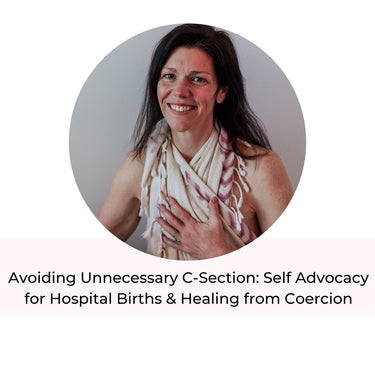
In this episode of Womb Stories Project, Kit Maloney, founder of Kitara, shares her raw birth story on a phone call with two sisters… just 3 weeks after giving birth (in her 40s) to a healthy baby girl.
An incorrect ultrasound report shows Kit’s baby in transverse position and completely derails her home birth plans. What followed was the very real possibility of an emergency C-section.
Her work with Kitara informed that moment. She recognized the pattern because she had heard it so many times. “Everything was fine, and then suddenly it became an emergency C-section.” With an EPIC labor support team ( her husband and midwife ) and years experience in women’s health and advocacy, Kit was able to have an unmedicated hospital birth within a highly medicalized system.
But what if she didn't? Her experience speaks to the importance of support in hospital birth, patient advocacy during labor, and how challenging it can be to navigate informed consent and avoid unnecessary birth interventions.
At one point, the situation escalated to threats of the Department of Health and Human Services being called. Kit found herself wondering, “how am I going to get out of here?” What followed wasn’t just about getting through the experience, but what it meant to come out the other side of it with a sense of agency and wholeness.
Birth trauma is real. Kit has come to see that a huge part of trauma prevention is being able to process more quickly. To be witnessed and affirmed almost in the moment of it can set you up for a totally different recovery.
This episode reaffirms the “why” behind the Womb Stories Project. Sharing our stories is an invaluable piece of spreading awareness, education, and advocacy within the women's health and wellness world. If this resonates, like, subscribe and share your birth story below in the comments.
Timestamps:
00:00 – Ultrasound Report Said Transverse
01:40 – Do I really need an emergency C-section?
03:20 – Advocating for yourself during birth
03:42 – Unmedicated hospital birth story
05:19 – Hospital Protocols After Birth
6:42 – Can I leave the hospital after giving birth?
14:20 - Ultrasound Mistake Almost Led to Unnecessary C-Section
17:56 - What does a Midwife really do? (in hospital)
18:45 - Induction with Pitocin or Misoprostol
19:42 – How to Prevent Birth Trauma (What Helped Me)
21:44 - Chanting During Unmedicated Birth
About Kitara and Womb Stories Project
Womb Stories Project is the in-house podcast of KitaraLove.com, your one stop shop for everything you need for safe and effective Yoni Steaming at home.
Kitara is a yoni steaming company made up of devoted womb healers. Our passion for steaming is rooted in the profound healing we’ve experienced ourselves and witnessed in those we support. We are devoted to supporting your womb health and healing journey.
Our founder, Kit Maloney, holds a Masters Degree in Gender & Social Policy from the London School of Economics and has spent the past two decades as a thought leader on victim advocacy, pleasure activism, and holistic womb health and healing.
Kitara provides beautifully designed, expertly crafted tools for safe and easy in-home yoni steaming.
Learn more about the benefits of yoni steaming
Follow Kitara on Instagram
Transcript
Kit Maloney (00:03)
Hi love. I have an episode for you today of Womb Stories Project that is deeply personal as they all end up being. But this one is a bit extra unexpected in that recording was something I thought was a private conversation. I decided now two years later to publish it.
And I don't think I've ever done that. I don't think I've had an audio of a conversation that I didn't realize was being recorded for publishing. I realized
on my daughter Dottie's second birthday, which was about two months ago, that I really wanted to speak more to that journey. I was thinking about all the different conversations I might have and the people who supported me through it and held the space and were there physically and energetically and lovingly. And I realized that actually three weeks after the birthing experience, I had one of my weekly sister calls,
that was just automatically recorded through the conference call line that we use.
And so here you have it. This is me three weeks postpartum, two years ago, speaking about what it was like to bring Dottie into the world after I have gone through the journey of giving birth the first time at home, thinking I would do that with her, receiving the news about 24, 36 hours before she arrived that there was a
botched ultrasound the result of which had this cascading effect of events that meant that under my state's laws, I was not able to birth at home with the midwife that I had chosen.
And so here's the story. Here's me two years ago, sharing in real time what it was like to both understand the ways in which I was being pressured, succumb to moments of victimhood within that.
Return time and time again to doing my best.
For myself, and for Dottie.
And then being gifted,
this incredible experience of what I have come to see as home birthing in a hospital.
And what a gem my daughter is to be the conduit to the gift of that experience. I suspect this topic will bring forth additional episodes on Womb Stories Project. I'm here for that. If you listen and you have questions, please ping them to me because I'd love to speak on this more. And what I hold for us all is that we get to have the births
that,
connect us to our power and our strength.
This birth did that in a way that was very surprising at times illuminated to me how much change we need to see in the way our culture thinks about birthing now and treats women's bodies and birthing people.
I love you. I thank you. I hope this conversation that I have with my sisters is interesting and potentially illuminating and thought provoking maybe even inspiring about how you think of birth in general and the different possibilities we might hold for ourselves.
I'm curious, I'm curious for how this one lands. Thank you.
Kit Sister (04:11)
This call is being recorded.
Kit Maloney (04:13)
I really want to finish drafting this letter to Maine Fetal Medicine. And they're the ones who made it so that I couldn't have a home birth because of the way they falsely reported my ultrasound.
Because they put that Dottie was in a position
called transverse, so it just means she's sideways instead of heads down. It made it so that Tiffany would lose her license if she engaged in a home birth with that being on the record as her position. And they wouldn't switch it, even though I was saying I had just been there two hours earlier, and that's not what the ultrasound said. It's not what the image showed.
is the work I still need to do integrate and release, but, they were fully prepared to make me have a C-section. If I was in a different place in my life or a different person, I would have had a C-section, a completely unnecessary emergency C-section,
that would have always been presented to me as necessary because nobody ever would have owned up that Dottie had been in a perfect head down position all the time. It was just that they botched their report. And I do feel pretty clear that I think the reason, I'm not sure they intentionally botched it because I was doing a home birth and I said I wasn't gonna take their recommendation to go in,
and i'd be immediately induced. And I just said, no, I'm going home. I'm going to talk to my midwife. I do think because I quote unquote, defied them, was a spitefulness to that. And it's really scary and really messed up. I'm so
up and I advocated and I had Renaud and Tiffany as advocates and we fought for the renewed ultrasound which showed what I knew, she's in the right position for a vaginal On the other hand, it was like,
the body that we were being talked about being operated on was not the most powerful person in the room. I had to play games and ask the right questions. I was not the centered voice in that room or decision making. And it was very scary and very disorienting and did help me see how usually I carry a lot of privilege and don't
have omnipresent awareness that I'm not going to be listened to. But to have that then was just so awful. And I could see being years down the line connected to something I do around changing Maine laws and potentially if I do decide to go more representative politics,
do real work around. I think that's sort of where part of my journey and story is right now Tiffany said something to me we got them to do the revised ultrasound. She was like, this is the work that you do in the world. We find this in the midwifery community too.
Of course this happening to Kit because she's being asked to have all of these different experiences as a way of being able to connect with more women and the vast experiences that women have through the system through home birth, etc. I was glad she could see that also,
I just, I don't want to have to live this for everyone. I was connected to like the beauty of it, the power of it, and also like my own resentment to it. But it also unlocked this okayness that was me realizing that there was probably some unquote purpose to all of it. But that also I didn't need to actually
have a C-section. Like in that moment something dropped in of like you can go through this experience and not the actual C-section and still be as powerful as you would be. I held so tightly to that message. I had these visions of them wheeling me and me like screaming.
into an operating room and I was like, you're not gonna let that happen. You're gonna fight for as much as you can to not have that be what happens. So it actual birth did happen at the hospital. Once I got to the labor and delivery room,
and it was a much bigger and much nicer room than I thought it was going to be. I came into some element, not like, not like full surrender, but like,
I'm gonna make the most of it and I'm gonna still have the experience that I wanna have. I think I really did. I was basically induced at around one o'clock in the afternoon with Pitocin and then I went into more active labor around nine o'clock at night and she was born at 12:30
in the around midnight. I did it. I had an unmedicated birth.
Tiffany
she gave me this unbelievable acupressure massage on my lower back. At one point, the nurses were asking her like how she knew all the things she knows and were trying to get her teach them different ways and things.
At the end of it, the nurse who had been with me for the nighttime shift, she was like, that was definitely the most unique birth I've ever attended. And it was weird. Like I kind of was like,
Thank you. Like, I didn't really know what she meant. And then what Tiffany and Muriel have helped me understand is that that woman probably never saw a natural That Maine Med, which is where I delivered, is where people go either if there's an emergency or if they're planning to give birth in a highly medicalized hospital so that they're very intentional about that.
Everything was oriented around that. So I didn't fit. And so much so they wanted to stitch me immediately after Dottie was born. I couldn't figure out why I needed to make that decision right then. I found out later that Tiffany had said to them,
you need to remember that she hasn't had an epidural. So if you are going to stitch her she needs an anesthetic. And what I do remember is the attending saying, we actually don't need you to make this decision right now. And me feeling this like total relief. But everything was just couched by me operating really differently, which felt very metaphorical.
They were like, okay, we're gonna move you up to pediatrics. I had been told by Tiffany primarily that's when you get a much smaller that I should be prepared to basically not like that experience, that there would be a lot of poking and prodding of Dottie and me,
and that it would be very, very much in contrast to how I would want to be with Dottie in her first hours. So I said to the nurse, we would like to go home as soon as possible though. And she turns to me and she's like, ⁓ you mean you just want to skip going upstairs altogether? I was like, that's an option, yes. I was like, yes, let's get out of here. And at this point it was 4 a.m.
She was like, okay, it might involve a lot of paperwork. You'd need to sign off that you understand that you're not getting these additional tests and da da da, I was like, that's fine, that's fine. We'll sign anything. Get me out of here. I've had a relatively good birth. The baby's great. Let's go home. An hour later. This is when attending was actually stitching me the nurse was like, whoa, I actually.
did not understand that I should probably not have offered that to you. They're saying that we can't do that and that you need to wait to be seen by an attending the morning. I didn't understand that there wasn't an attending in paeds at the time. So I was just like, can't we see the person now get cleared and go? The nurse, she says to me,
look, if you want me this, I will. And I was like, okay. I was like, then do. Then, she said, I feel like I should also tell you that our charge nurse just heard that I was making this request and she told me that this might lead to us calling the Department
of Health and Human Services on you and your family. I think some guide or angel came down and breathed into me because I somehow stayed pretty calm and I was like, well, we're obviously not gonna do something that's gonna have that happen. And the attending at that point looks up at the nurse and goes, I would really hope
that that would not The attending says, you need to have somebody from come down and talk to these people now. Things are getting lost in translation on phone calls. And so I felt like, okay, great. Here's this doctor who's getting it. She had been pretty quiet, we could kind of sense that some of the nurses didn't have the best relationship with her.
So she's finished stitching Before she left, I thanked her. And then I said, Dr. Carol, I know this might not be possible, but
Dr. Carol to be in the room with me when somebody from paeds came in and she was like, I can do that. She was like, I should let you know, I will not have authority in that conversation because it's a discussion about you guys going up to paeds but I can be in the room with you for it. think what ended up happening was that she actually called them,
and was like, what the fuck are you doing threatening these people to call the Department of Health and Human Services. resident from paeds ended up calling down to my room wanting to speak to me. she was on the verge of tears. And like they were just all freaking out. I was like,
this is something you guys recommended, you guys said to me, like I said, I just want to leave here as soon as possible. You said that maybe I could bypass this. Like I was like, fine, we'll go up we'll go up I was like, but what I want is assurance that when this attending arrives in the morning, that we are seen by her first. And she was like, yes, you have my word. So we went up there. We were up there for like three hours. It was fine, except, except
our nurse was talking to the paeds nurse, but there was a curtain in between us and she was relaying all of the information for me and Dottie to the new nurse, but I wasn't part of the conversation. And finally, opened the curtain and was like, I just really want to make sure I'm hearing all I chimed in when I needed to.
This is a kind of minor, but it gets to an issue later, like the room was freezing. I like mentioned it and then complained about it an hour later. The pediatric attending does come, at like 8:30 or 9 in the morning. We try to be super nice friendly with her we sign all this paperwork that we don't need all those checkups and pokes and prods It's super condescending, but I hold my own.
She was like, can we just take Dottie's temperature one last time? And not thinking, I'm like, yeah, fine. And Her temperature is low. And I'm like, It's freezing in here. And they were like, well, this now puts that we can't discharge you if her temperature is... And I'm like what's her temperature? Like it was like 0.2 degrees lower than their arbitrary scale.
And I'm so over it with their fucking arbitrary scales and like their arbitrary amniotic fluid and everything else. It's just about keeping you in their system. At this point I'm like, it's cold in here. And they're like, yeah, we get that, when babies aren't able to hold their temperature, it could be a sign of a bacterial infection. I'm like I guess that it could be this, it could be that. There's no evidence that she can't hold your temperature. It's cold.
So now we need to take blood sugar. So now you need to poke her? I was like, let me feed her first. I haven't fed her in two hours. Because we keep thinking we're going to leave. And they were like, no, we can't let you feed her because we have to get the blood sugar as soon as possible to the low temperature reading. It was just all nonsense. I am so over this.
At this point, a little bit of panic was setting in. I have been threatened, I have been coerced. And now I cannot seem to get myself and my child out of this hell,
where they just create fucking problems so they can solve them. But another angel stepped in and somehow Dottie's blood sugar wasn't low. I was shocked to tell you the truth. I was certain it would be and it would further this cascade tests.
I had, as soon as they had said her temperature was low, put her chest to chest, and her temperature came right back up because it was never an issue. It was an issue with the fucking cold room, which she never would have been in if she was at home. But anyway, so then we got home and it was amazing. I've now been just trying to figure out how to wrap this, all of that, and my own sense of what does it mean, what does it not mean.
It just took so much energy to try to placate and like massage their egos. I would be like, we're really grateful for everything you've done.
I have an almost two-year-old. I recovered with him at home. I have professional support at home. My midwife's visiting us several times in the next, several days. Like, we're getting all these tests that you do here done. We're just having them done at home. We bring a lot of intentional and
strategy to this. And they were like, no, we do understand. We do understand. We do appreciate that. Tiffany she's given me such good advice. She told me the things that I would need to do. They're really hung up on a vitamin K shot. And apparently like, I don't know.
I have done all the research. I take it or leave it. You're not born with vitamin K. It's what helps you clot blood. So if you do have a blood clot and you don't get a shot of vitamin K, it can be very dangerous. On the other hand, there's probably a reason you're not born with vitamin K if that's how we evolved that way, da da da. But she was like, if you don't want a vitamin K shot, just know it's gonna be a thing. And so I signed up for the vitamin K shot. I was like, it'll be fine.
And that even came up where the pediatric attending, when I said to her, I was like, we just want to go home. We bring a lot of intention into our decisions. This is not being done flippantly or callously. We just know for ourselves, for our family, for our new baby, it's better for us to recover at home. And she was like, I do feel that. I do feel that. I mean, even that you had the vitamin K, like if you hadn't had the vitamin K, I might be pushing back on you on this.
Kit Sister (17:55)
I remember like vitamin K drops or something and having those and doing those or something after the
Kit Maloney (18:01)
Tiffany been really good about setting expectations. She was like, after you deliver here, they're going to want to keep you for 48 might be able to get out in 24 to 36. And I was like, that's going to be really hard for me. She was like, that's why I'm mentioning standard of yourself prepared. Then she just slid in,
sometimes the Amish get out within 12 hours. And I just had this moment and I was just like, was like, I think I was being told like, you have no chance. But what I hear is the there is a loophole.
That is amazing. It's so amazing.
Kit Sister (18:41)
Amish woman now like raise the bar. Wait I have a question has Tiffany ever done a birth in the hospital like that before or was that the first time?
Kit Maloney (18:44)
Okay.
No, has. And she has such an amazing reputation there. In a different kind of life, she actually worked at Maine Med like, 15 years ago. And she's had this happen before. So nurses and even the attending she didn't know any of them, but
it felt like more often than not when they came in to introduce themselves to us, they would be like, I've heard such great things about you. It's nice to meet you.
Kit Sister (19:12)
So with the ultrasound, was it just like one person read it wrong or like do you have a copy of it?
Kit Maloney (19:18)
I do, have a copy of it. Yeah, it was the sonographer. She was like, your amniotic fluid is at a 5.2 and we like it at a 6. So I'm bringing a doctor talk with you. was the doctor's gonna recommend that you go right into delivery. And I said,
Honestly, this is what I think started the whole thing. I said, well, I'm not gonna do that. And the sonographer left. I said to my mom, hours later, I knew I shouldn't have been rude. And my mom was like, what are you even referencing? And I told her that. She was like, Kit, that wasn't rude. I was like, I know and
they have this total authority. Once they write up the ultrasounds there's no defying it. You are automatically, talk about the hamster wheel, you are put into whatever they recommend. And nobody can go against it without running the risk of losing their license. So what happened is that the doc came in, talked to me about the amniotic fluid,
said, our baseline is a six. If you're under six, we recommend immediate delivery. And I was like, okay, well, my midwife saying that in the midwifery community, the baseline is a five per meter. And she was like, yep, that's another metric. She said, there is not a scientific reason for certain Some people use five, we use six. Some people use the deepest one single pocket of amniotic fluid.
And I was like, thank you for explaining, but I'm gonna go home now and consult with my midwife further. Tiffany calls me an hour later and she's like, Kit, this report says that Dottie is in transverse position. And I was like, Tiffany, she's not. I was like, they opened ultrasound.
confirming, it with my eyes on the screen. Her head is down. She said her head is down in the pelvis. My mom was at that appointment with me, thank God. My mom was listening to me talk to Tiffany and she's like, I was there. I saw it. I heard it. When the doctor came in to talk about the amniotic fluid. She didn't mention anything about the baby's position to try to get me to go in to delivery and she would have if it had been an issue.
So I stupidly said to Tiffany, it's just a mistake. Can you just call them and explain? And she was like, OK. And then she called and they stuck by it. They were like, the report says it's transverse. It must be transverse.
And then that's what Tiffany explains to me. Now I have written and verbal confirmation that they're sticking by this. I am now no longer legally able to attend your birth at home.
Tiffany she was in a really uncomfortable situation because she was looking at a professional report that is in complete counter to what her client patient is saying.
Honestly my work with Kitara and the stories I've heard, informed so much advocacy for myself. Cause I've just heard the story, the story of like, everything was fine, but then somehow all of sudden I needed an emergency C-section and I didn't think I did, but they were certain I did, so I did.
And it's never felt right. Like I have heard that so many times and I was like, this is what they're trying to do to me. I am aware and I do this professionally. I said so many times to my mom and Renno and Tiffany, if I need a C-section to protect myself or Dottie of course I will have one. I was like, this is not, I don't need one for this.
Like, they have to give me another ultrasound. Like, I'm not gonna have one just because they are mad at me for being empowered.
Kit Sister (22:38)
I think it says a lot about Tiffany that how to play by the rules and maintain her standard. I think it says a lot about her integrity.
Kit Maloney (22:48)
Yeah, yeah, no, I mean, I wouldn't have thought it was possible, but I think even more highly of was able to have a good birth on my own terms at the hospital. And I don't imagine that could have been possible without her because the basic flow of information was that a nurse or a doc would come in, they would spout a bunch of stuff.
And then I would say, okay, thank you. Let me think about that. And then Tiffany would explain it in a way that made sense to me and give me so much more background information about the different drug options and everything. were a couple of things that were just
thrown out and they would land not well in my body and the people would leave and I'd ask Tiffany about it and she would explain it completely differently and I'd be like, that's why that didn't land. That would totally not be aligned for me. Like one was Misoprostol which is part of the drug that you take when you want abort a pregnancy. So I knew that term and they were like, well, we use Misoprostol to induce
which makes sense, that like inducing a delivery and inducing an abortion would like overlap. I asked Tiffany, was like, isn't that what they use? And it can get really intense. And she was like, well, what they didn't explain to you was that you can't control Misoprostol like once you've taken it, you can't then lower or adjust it like you can with the Pitocin So if you or Dottie don't react well to it,
the only way to correct is C-section. I was like, what the fuck? So again, that was one of the more extreme examples, but it was throughout the whole 24, 48 hours of dealing with them Tiffany would just step in and reframe something or give me more information than they were going to. That shifted my decision pretty dramatically often.
Kit Sister (24:34)
How long did Tiffany stay with you at the hospital for?
Kit Maloney (24:37)
She came to OB Triage on Friday afternoon. She was with us from like 1 o'clock in the afternoon until we left at like 7 o'clock at night. Then she met us when we went back on Saturday. She got there at 1 o'clock in the afternoon. She was with us through the birth and she left around 4 in the morning.
It was amazing. And then she was at our house on Monday night. Sat with me for two hours to process it all. That's another thing that I to remember to share when I do share this. The amount that I was able to process with you guys in the WhatsApp group, with Muriel, with Tiffany, like I got access to immediately work
out my story and figure it out and get it it oriented in my awareness, and be affirmed and have questions answered. And I've really come to see I think that's a huge part of trauma prevention, if we can process more quickly and be witnessed and affirmed, almost like in the moment of it, it
maybe it's just me, but it can set yourself up for a totally different recovery. I think particularly with birthing. I think through the different stories I've heard with Kitara people who were able to have that level of care, somebody to really sit with them and let them process their birth story.
They don't have the trauma land in the same way as those. I mean, it makes sense that we're like silenced or told that it didn't quite happen that way or didn't happen that way at all. It's that, that layers on.
Kit Sister (26:13)
Yeah.
So inspirational.
I just feel like this is fuel to your fire and you're gonna create something really incredible out of this experience. At least one thing really incredible. I just think there's gold in this for you.
Kit Maloney (26:27)
Thank you. Thank you. Yay. Thank you. I really appreciate you sharing that and then also,
I'll share one other aspect that I just thought was so cool, which is I started chanting. I would never be able to do it outside of the birth portal, but it was just like.
almost like chanting. It felt very like an organ should be playing. And it was so weird, but whenever I made these sounds, and expanded. And so I just kept doing it. Then I was given these visuals of what positions to move into. And it was super wild.
I got this visual I was standing up and had my arms on the bed. And then I got this very clear visual of being on all fours on the floor. That was my final position with Mark. I was like, no, no, I'm not, I can tell I'm not giving birth to her in that position. That can't be right, that can't be right. I just kept seeing it.
I was like, if I get in that position, I'll never be able to stand up again. I just felt this like, it doesn't matter. It doesn't matter. Just get in a position. You won't need to stand up again. And I was like, but I know I'm not going to give birth in that position. I was just really resisting it. And finally, I was like, fuck it. So I got down on all fours. And then almost as soon as I was like in the all fours, I saw this other, I was like pushing there for a moment. And then I saw this other image and it was just of my body and it didn't make any sense to me.
It looks like I was lying on my back on the floor, but my right arm was over my head. And I was like, this is so weird. I was like, why would I want to laying flat on my back? Like, I don't get it. I don't get it. I kept seeing it. So I got into that position. And with that, Tiffany gets underneath my right shoulder I'm being fully supported by her. So I'm at this
angle actually and Dottie's birth within five minutes. ⁓
Kit Sister (28:21)
my god.
Kit Maloney (28:22)
⁓ Wow. Wild and awesome.
Kit Sister (28:25)
Oh my god. You've got to write this all down.
Kit Maloney (28:29)
so cool. couple of nurses actually had said, like, are you a singer? I was like, no. I was like, can't sing at all. I don't know where those sounds are coming from.
Kit Sister (28:37)
You know, they're probably still talking about you, by the way. Remember that woman a few weeks ago?
Kit Maloney (28:43)
Even when we got up to paeds my nurse said, birth reminded me why I wanted to get into this work.
And I was like, so you guys don't see birth like this? And she was like, no.
Kit Maloney (28:58)
Thank you for listening to my birthing story.
I have a...
mentor who speaks about how one of the most beautiful gifts in leadership is to allow yourself the opportunity to stand on your story when you share it rather than be in it when you share it.
And this is an interesting one for me because I'm sharing this recording from just three weeks after Dottie's birth, but I'm sharing a conversation
that is with Soul Sisters. If I had recorded three weeks after Dottie's birth, I would have been so much more in my story. I was freaking pissed. I was so rageful. And I still carry that. And by standing on top of your story, I don't think you necessarily
don't have the rage, but there's a transmission and alchemy of that rage that allows us, hopefully allows me hopefully to share the story in a frequency that is able to be felt with more of a frequency of healing and possibility than of cycling victim energy. And that certainly is my prayer and hope.
for this episode that you just listened to. And I thank you for honoring where I am now and being part of my own healing journey for it because...
it was presenced to me a couple of weeks after this conversation when I came to some very trusted women in my life and I said, hey, I'm in like a anxiety space that's like.
we're touching, if not on the line of some serious postpartum stuff. And what was so healing to me in that moment was a reminder of how important it is for me to speak my story, for me to share what happened, for me to do so though in spaces that felt safe to me, where I knew I would be held. And so I did that as a practice alongside steam alongside other things, but really storytelling,
sisterhood, and steam, sisterhood and steam. This was my practice and my way out of what in so many other ways for me could have been an inevitability of a diagnosis of postpartum anxiety or depression because of,
what was endured during this birth. So I am so sincerely grateful to you for being a part of this because when we listen to each other's stories,
three weeks, two years after.
It's healing, it's healing to be seen and to be heard and to be believed. And this is what I am so grateful to have experience and privilege in receiving in my own life and what I hope to spread and to be a part of in witnessing and celebrating and honoring the stories of others. So thank you, thank you, thank you. And I have created some additional
in-depth PDFs for our Kitara community on steaming and this type of processing for fertility journeys, as well as postpartum recovery. So you can find those on kitaralove.com now in the benefits of steam section on the website,
and you can get for free a lengthy download that I've designed both visually and through the written content, written myself the knowledge, the wisdom that I have developed over decades of this work.
Thank you, love. You're so special and so dear, and I am so grateful.